Hello Erik
Let’s take a look at the network diagram once again:
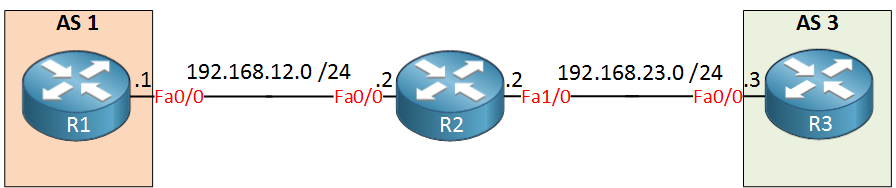
Assume that there’s a loopback interface on R1 with an address of 1.1.1.1/32.
Now when a router has an IP packet that it wants to send (whether that packet is generated by the router itself or it is a packet that has entered from another interface), it must decide out of which interface it must send it. To do so, it takes the destination address of the packet and compares it to the entires in its local routing table. If an entry is found, it sends it out of the appropriate interface. If an entry is not found, it drops the packet.
Now if R3 is trying to ping 1.1.1.1, it will look in its own routing table. Since there is no such entry, and since there is no configured default route, the packet will be dropped.
Keep in mind that the next hop is not contained within the packet itself, but is derived from the local routing table. Note that this whole process is independent of any BGP or multi-hop configurations.
For more information about this routing table lookup process, take a look at the following lesson.
I hope this has been helpful!
Laz