Hello, everyone.
I have a few questions regarding SP architectures.
When it comes to Unified MPLS, a Cisco doc says this:
The purpose of Unified MPLS is all about scaling. In order to scale an MPLS network, where there are different types of patforms and services in parts of the network, it makes sense to split the network into different areas. A typical design introduces a hierarchy that has a core in the center with aggregation on the side
Is the Access/Aggregation/Core design only used when talking about unified MPLS or can it be used when talking about the SP’s architecture in general? For example, we don’t run unified MPLS at work but we still use the terms such as Edge/Core, and so on.
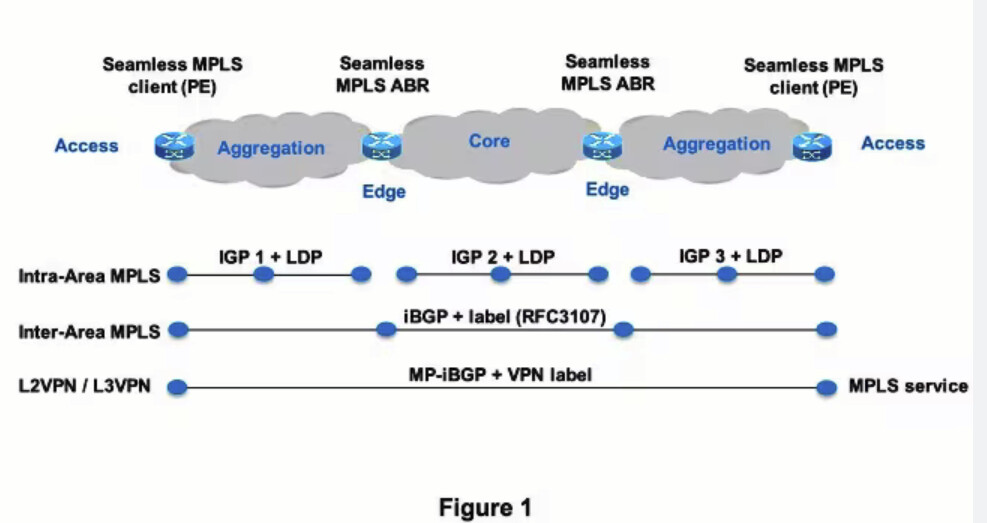
In this scenario, the MPLS ABR isn’t exactly like an OSPF ABR, right? The terms are the same but in MPLS, it just means that this router sits at the edge of the IGP/LDP domain (or an IGP island if I may call it that)
And one final question, do the IGP domains need to be designed in a way where each aggregation layer (and core) runs its own IGP?
So for example Aggreg1 will run OSPF1, Aggreg2 will run OSPF2, Core will run OSPF3. My question is, can these mix? Can I include, say 1 router from the core layer in the same IGP that is in the Aggreg layer?
From what I understand, that is the “typical” design but we can of course change/mix things or add more IGP domains, if we have such requirements.
That’s all, thank you 
David