EIGRP Default Network Route

Hi Laz,
Thank you for your response. Sorry the router was labelled wrong. Please see the topology below
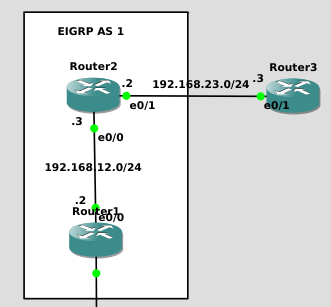
Regarding this comment:
Secondly, on Router 1 as described in the configs, you don’t seem to have any configs for the default route, but afterwards in the routing table, the default route appears. So I assume that is configured correctly.

I did not configured default route for R1 because when I set a default route to R2 and added it to EIGRP, the routing table to R1 got updated with the default route. Do I still need to add default route to R1?

I have yet another question and sorry for making this long. I went ahead and add 2 more routers for learning purpose. Please see the topology below.
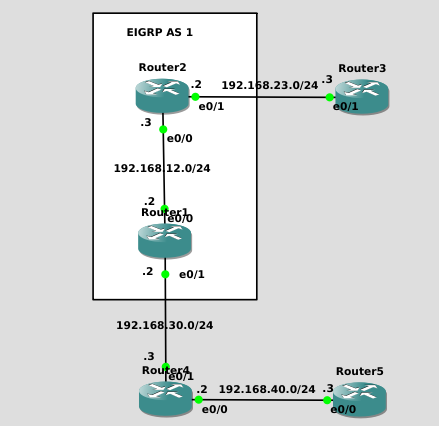
Following Default routes are added to router 4 and 5 receptively.

Router 4
ip route 0.0.0.0 0.0.0.0 192.168.30.2

Router 5
ip router 0.0.0.0 0.0.0.0 192.168.40.2

on Router 1
I have added the default route to 192.168.40.0/24 network
IP route 192.168.40.0 255.255.255.0 Ethernet0/1
I have added the static route to EIGRP 1 so that router 2 is aware of the 192.168.40.0/24 network. Rest of the connections are same as per the lab in the lecture. I can ping from any router to other router. My question is regarding the routing table for R1 and R2

Router 1

Router1#sh ip route eigrp 
Codes: L - local, C - connected, S - static, R - RIP, M - mobile, B - BGP
       D - EIGRP, EX - EIGRP external, O - OSPF, IA - OSPF inter area 
       N1 - OSPF NSSA external type 1, N2 - OSPF NSSA external type 2
       E1 - OSPF external type 1, E2 - OSPF external type 2
       i - IS-IS, su - IS-IS summary, L1 - IS-IS level-1, L2 - IS-IS level-2
       ia - IS-IS inter area, * - candidate default, U - per-user static route
       o - ODR, P - periodic downloaded static route, H - NHRP, l - LISP
       a - application route
       + - replicated route, % - next hop override

Gateway of last resort is 192.168.12.3 to network 0.0.0.0

D*    0.0.0.0/0 [90/307200] via 192.168.12.3, 00:43:21, Ethernet0/0
D     192.168.23.0/24 [90/307200] via 192.168.12.3, 01:17:38, Ethernet0/0

Router 2

Router2#sh ip route eigrp 
Codes: L - local, C - connected, S - static, R - RIP, M - mobile, B - BGP
       D - EIGRP, EX - EIGRP external, O - OSPF, IA - OSPF inter area 
       N1 - OSPF NSSA external type 1, N2 - OSPF NSSA external type 2
       E1 - OSPF external type 1, E2 - OSPF external type 2
       i - IS-IS, su - IS-IS summary, L1 - IS-IS level-1, L2 - IS-IS level-2
       ia - IS-IS inter area, * - candidate default, U - per-user static route
       o - ODR, P - periodic downloaded static route, H - NHRP, l - LISP
       a - application route
       + - replicated route, % - next hop override

Gateway of last resort is 0.0.0.0 to network 0.0.0.0

D     192.168.30.0/24 [90/307200] via 192.168.12.2, 00:41:06, Ethernet0/0
D     192.168.40.0/24 [90/307200] via 192.168.12.2, 00:25:12, Ethernet0/0

R1 has D* 0.0.0.0/0 [90/307200] via 192.168.12.3, 00:43:21, Ethernet0/0
this route set as default route, which its is learning from R2.

But, R2 does not show D* for D 192.168.40.0/24 [90/307200] via 192.168.12.2, 00:25:12, Ethernet0/0 even though it is set as the default route for R1 and added to EIGRP. I was expecting the EIGRP routing table in R2 to have D* for D 192.168.40.0/24 [90/307200] via 192.168.12.2, 00:25:12, Ethernet0/0

Can you please advise? Once again really appreciate all the help.

Hello Shamal

You’re absolutely right! That paragraph got into the post accidentally. As I was writing, I realized that what I was writing was incorrect, and I thought I had deleted it. I have since corrected my post.

Concerning your second question:

The D 192.168.30.0/24 [90/307200] via 192.168.12.2, 00:41:06, Ethernet0/0 route is not a candidate default route because it is not a default route. A default route is characterized by the 0.0.0.0/0 network. This is simply a route to the 192.168.40.0/24 network. It seems like Router 2 is not receiving any information about a default route via EIGRP. Does that make sense?

I hope this has been helpful!

Laz

First of all, I really don’t get this default route thing, while we can use redistribution.
Secondly, I am not getting the default route as *D, it’s still D only.
This is my configuration on R2
router eigrp 12
network 12.0.0.0
network 23.0.0.0
ip default-network 23.1.1.0

Hello speedosuper111.

The default network command is dead and should not work on modern IOS. Sometimes it won’t do what you want and sometimes the command won’t work at all.

The overall command is pretty confusing. We aren’t really used to seeing any other than 0.0.0.0/0 as the default route.

In this case, the 192.168.23.0/24 is the default route. EIGRP tells the neighbors that this network should be considered as the last resort.

The best and most common practice these days is to use redistribution, summarization, or configure the route manually. You won’t really see anyone use this command because it’s confusing, not available on modern IOS, and the default route should always be 0.0.0.0/0 - that’s also why the command is considered dead these days. There are a couple more of reasons for that but this is one of them.

To summarize it, it’s an old command that sets the network to be eligible to be the default and will not work on modern IOS. It’s no longer used and the best practice is to install a default route into EIGRP by redistributing it, configuring a static route, or by doing summary-address 0.0.0.0/0

David

Hello Speedosuper111

I agree completely with @davidilles that in modern networks, ip default-network is NOT a preferred method. The only reason it’s still taught is for legacy network support and certification exam coverage.

The ip default-network command is a legacy, classful EIGRP-specific command used when your path to the outside is through another network that is already running EIGRP. You’re essentially “electing” an internal EIGRP network to be the path of last resort.

The preferred method is to create a static default route pointing to an ISP. You create ip route 0.0.0.0 0.0.0.0 [next-hop] and then redistribute it into EIGRP. Such a redistributed route appears as D*EX 0.0.0.0/0 on receiving routers.

So in your configuration, why are you seeing D instead of D*? There are two issues with your config.

First, the incorrect network is specified. Remember, the ip default-network command only works for CLASSFUL networks. The network 23.0.0.0 is a Class A network with a natural /8 mask, so you must use ip default-network 23.0.0.0.

Secondly, the * appears only on routers that are receiving the candidate default route, not on those originating it. So you have to check the results on the neighboring router.

This Cisco document further describes how this feature behaves when it comes to classful and classless use.

But you’re right, today redistribution is the way to go for advertising default routes in EIGRP.

I hope this has been helpful!

Laz