Hello Lukas
The quick answer: The use of the LLC depends on which Ethernet standard is being used. Ethernet has two standards: IEEE 802.3 and Ethernet II. The first uses LLC while the second does not.
The detailed answer: The main difference between IEEE 802.3 and Ethernet II is the definition of the two-byte field that comes right after the source MAC address.
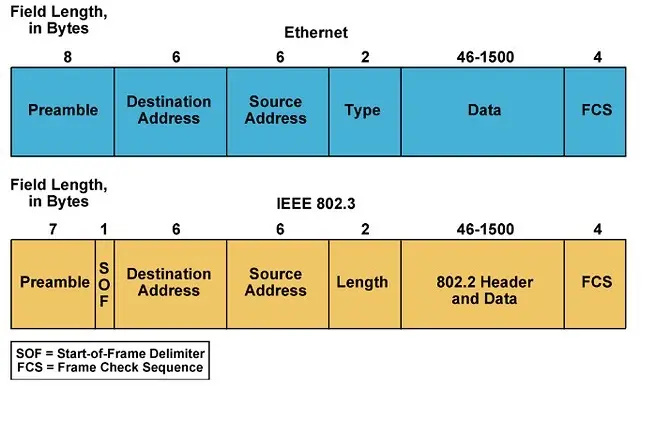
This is the Type field for Ethernet II and the Length field for IEEE 802.3. It is the value found in this field that will determine which type of Ethernet you are using.
- Type field = contains a value that indicates what Layer 3 protocol is being used. For example, a hex value of 0x0800 indicates IPv4 and 0x86DD indicates IPv6. Used by Ethernet II
- Length field = contains the length of the frame in bytes, with a maximum value of 1500 bytes. Used by IEEE802.3
For values greater than or equal to 1536, the frame must be an Ethernet II frame, while for values less than or equal to 1500, the frame must be an IEEE802.3 Ethernet frame. (Values from 1501 to 1535 are undefined). When standardizing Ethernet, both standards were acceptable, and can coexist on the same network, and are differentiated in this way.
Now when using IEEE802.3, the recipient still needs to know how to interpret the frame. So this standard required an IEEE802.2 (LLC) header to include the type of Layer 3 protocol being used.
Today IP networks use Ethernet II, simply because the field after the Source MAC address must contain the IPv4 or IPv6 type value. So in most cases, LLC will exist only for Layer 3 protocols other than IPv4 and IPv6.
I hope this has been helpful!
Laz