Hello Sims.
When designing frame-relay topologies, there are a couple of options.
First you can create a point-to-multipoint topology where each router on the frame-relay network has an IP address within the same subnet. Let’s say the subnet is 10.10.10.0/24. Take a look at the following diagram and assume that each S0/0 interface of each router has an IP address of 10.10.10.X/24:
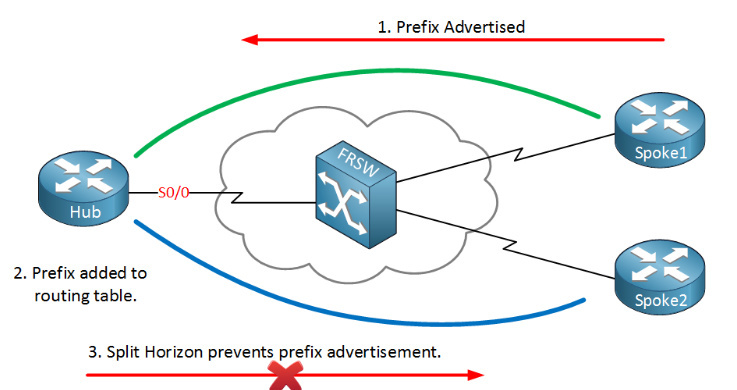
Keep in mind that point-to-multipoint means that Spoke1 cannot communicate directly with Spoke2. All communication between them MUST go through the Hub router. The Hub is the “point” and the Spokes are the “multipoints.”
So, using a routing protocol like EIGRP or OSPF, Spoke1 sends a routing update to the Hub router. Because of the split horizon rule, Spoke 2 will NEVER receive this update.
(Split horizon rule states that no routing update will be sent out of the same interface that it was received on. This is used to prevent routing loops.)
So because the Hub router received the routing update on S0/0, it will not send it out from there.
To solve this split-horizon problem, you can create point-to-point links between the routers such that each router has a direct path to every other router using subinterfaces. Take a look at the following figure:
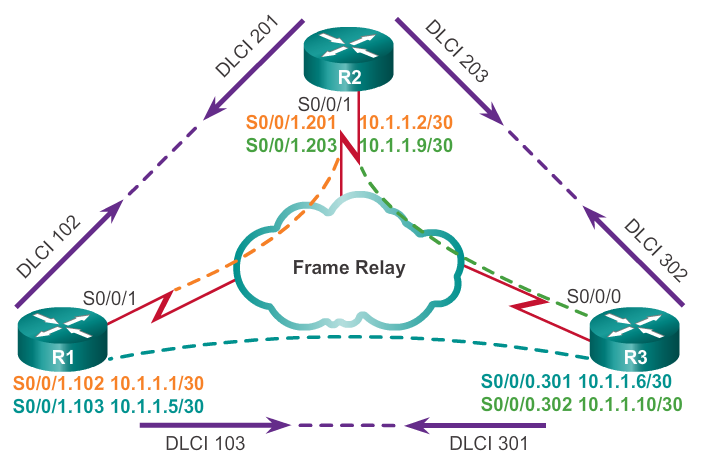
Here you can see that there are subinterfaces configured on each of the serial links and each subinterface connects to a single subinterface on another router. The point to multipoint links are replaced by three point to point links, each with its own subnet. So now, for example, any advertisements that are received via subinterface S0/0/1.102 on R1 can be readvertised via S0/0/1.103 on the same router without violating the split-horizon rule.
Note that even though the readvertisement is exiting the same PHYSICAL interface, it is in essence exiting a different LOGICAL (sub)interface, thus it is not violating the split-horizon rule.
I hope this has been helpful!
Laz