Thanks. I just fixed this.
Hello, everyone.
OSPFv3 can run multiple processes on an interface which did not work with v2
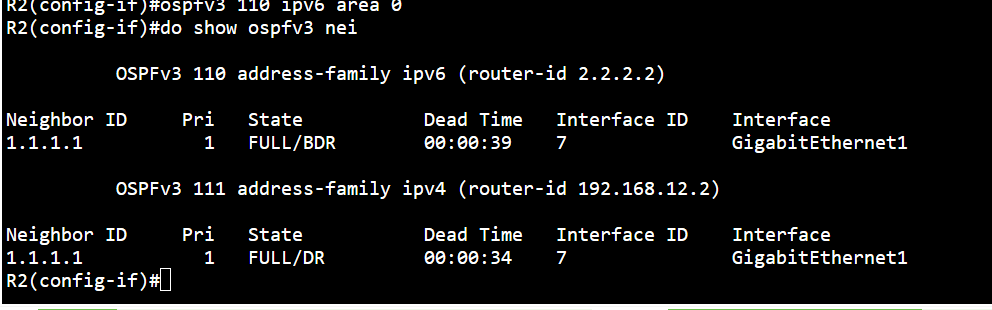
If I can just configure a different OSPF process, why should I ever bother with the instance ID?
A quick example but if I have different kinds of routing information that needs to be exchanged, I can just separate them out into their own processes and then form adjacencies with the appropriate routers. In that case, I would not use the instance ID. At this point, the instance ID just seems like a value that needs to match during the adjacency but it doesn’t seem to me that Cisco’s OSPFv3 implementation has proper support for instance IDs the way they were intended. It’s just a value that has to match, you cannot tell the instance ID to only include a certain set of routing information…
The idea with the standard after reading it is that you could run multiple OSPFv3 instances over a single interface and use the instance ID to differentiate peerings but I don’t think that Cisco has implemented this kind of functionality.
(oh and for anyone wondering, XR’s OSPFv3 implementation does not support IPv4 address family (yet) )
Thank you
David
Hello David
This is a subtle but important aspect of OSPFv3 implementation. You’ve identified most of the issues concerning this topic, but let me explain a bit more about these concepts of OSPF process IDs and instance IDs, and I’ll also talk a bit about whether Cisco implements instance IDs as the standard intended.
The OSPF Process ID is a locally significant configuration identifier only. It never appears within OSPF messages. It’s used to separate LSDBs, SPF calculations, and routing tables that belong to different OSPF processes within a single router resulting in completely independent routing domains per process.
The OSPFv3 Instance ID is an 8-bit field in the OSPFv3 packet header. It’s sent within every OSPFv3 packet, and must match between neighbors for adjacency to form. It acts as a protocol-level demultiplexing mechanism.
What is the purpose of the Instance ID? Imagine this scenario: You run two OSPF processes (process 1 and process 2) on the same physical interface. When an OSPFv3 Hello packet arrives at that interface, the router must answer: “Which OSPF process should handle this packet?”
Since both processes use the same link-local addresses and same Layer 2 segment, the router cannot distinguish based on IP headers alone. This is where instance ID becomes important. It’s the tag in the OSPFv3 header that tells the router which process/instance the packet belongs to.
You are absolutely right that in Cisco’s implementation, instance ID primarily acts as an adjacency matching parameter rather than offering granular control over which routing information gets exchanged. You cannot configure instance ID to filter specific routes or carry different subsets of routing information, but that’s not what it’s designed to do. Instance ID doesn’t filter within an LSDB, but it separates which LSDB the packets belong to in the first place.
For this reason, even though Cisco implements it in a limited manner compared to the RFC, instance ID still serves important purposes. One of the most important is Address Family Separation (RFC 5838) where Instance IDs 0-31 are reserved for IPv6 unicast, and Instance IDs 64-95 are reserved for IPv4 unicast.
When you configure OSPFv3 for IPv4 address family, Cisco automatically uses instance ID 64 (by default). This prevents IPv4 and IPv6 OSPF sessions from accidentally interfering with each other on the same link.
So although you can’t directly configure instance ID in any detailed way on Cisco devices, it still employs it for the purposes I’ve shared. Does that make sense?
I hope this has been helpful!
Laz
Hello Laz.
Perfect, thank you!
David
1 Like
Why did the router create a neighbor adjacency without you explicitly configuring the router-id? I see in the database that it used the physical interface IP address and not the Loopback. When using OSPFv3 and ipv6, shouldn’t you have to manually configure the router-id to establish neighbors?
Hello Roger
Indeed, when using OSPFv3, you still need a 32-bit value to act as the router ID. However, OSPFv3 still uses the same mechanism to obtain that 32-bit value automatically. If there is no manually configured router ID, then the router will use the highest IPv4 address on a loopback interface, and if that doesn’t exist, the highest IPv4 address on a non-loopback interface.
In this lab, we have an IPv4 address assigned to a physical interface, so the router uses that as the router ID. The only time OSPFv3 will not form an adjacency is if there is no manually configured router ID AND there are no interfaces, loopback or physical, with IPv4 addresses.
Now as I was doing my research, I did come across this interesting note in RFC 5340:
Because the size of the Router ID is smaller than an IPv6 address, it
cannot be set to one of the router’s IPv6 addresses (as is commonly
done for IPv4). Possible Router ID assignment procedures for IPv6
include: a) assign the IPv6 Router ID as one of the router’s IPv4
addresses or b) assign IPv6 Router IDs through some local
administrative procedure (similar to procedures used by manufacturers
to assign product serial numbers).
This statement gives leeway to manufacturers to create their own method of assigning router IDs, even giving them the possibility of using an IPv6 address for that. However, the RFC describes these as “possible” procedures, not mandatory ones. But I don’t know of any vendors that have chosen to move away from the more conventional method.
I hope this has been helpful!
Laz